

Webinar
Webinar: How to Manage Your AI Project … with AI!
MS Teams Webinar,
Langue(s) de l'événement
English
Tarif : Free of Charge
S'inscrireDiscover how project managers, PMO teams and stakeholders can use AI throughout the project lifecycle to improve clarity and delivery.
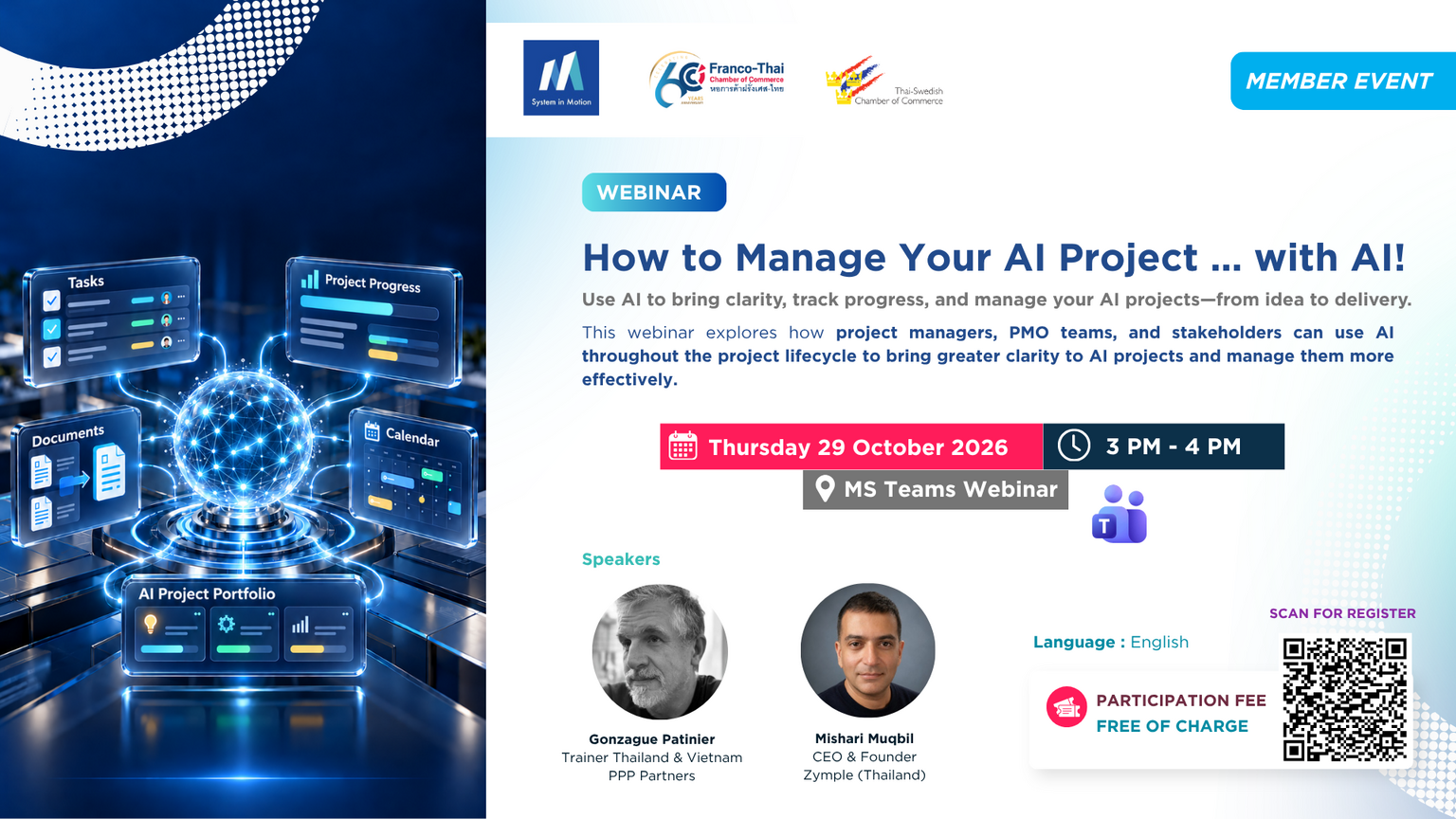
Franco-Thai Chamber of Commerce is pleased to invite you to the webinar on the topic "How to Manage Your AI Project ... with AI" in collaboration with System in Motion.
Artificial Intelligence is rapidly moving from experimentation to real business transformation. Many organizations begin with simple prompts and productivity tools, but soon face more complex questions: Which AI use cases should we prioritize? How do we align stakeholders? How can we manage scope, risks, decisions, and delivery as initiatives evolve?
This webinar explores how project managers, PMO teams, and stakeholders can use AI throughout the project lifecycle to bring greater clarity to AI projects and manage them more effectively.
As a practical next step, we will introduce the AI Project PMO Improvement Workshop—an interactive learning experience designed to help organizations put in place the minimum viable PMO setup required for reliable project and portfolio tracking.
The workshop is based on the P3.express framework, a lightweight and practical project-management method that brings clarity and discipline without unnecessary bureaucracy. P3.express focuses on essential practices: defining objectives, identifying stakeholders, planning work, tracking progress, managing decisions, and learning from results.
Participants will work through realistic AI project use cases, including the development of a generative-AI document-processing solution. Following the P3.express structure, they will work through the project step by step—from the initial idea through planning, execution, review, and continuous improvement.
At each stage, participants will explore how AI can help project managers, PMO teams, and stakeholders clarify project information and improve portfolio visibility. Typical applications include:
- refining the problem statement, objectives, expected benefits, and strategic alignment;
- identifying stakeholders, needs, assumptions, dependencies, and concerns;
- clarifying scope, requirements, risks, priorities, and success criteria;
- preparing project plans, iteration goals, meeting agendas, status reports, and project communications;
- summarizing progress, decisions, issues, risks, and next actions;
- consolidating consistent project information for portfolio reporting, prioritization, and decision-making;
- supporting project reviews, lessons learned, and recommendations for the next phase.
The objective is not to create a heavy PMO. Instead, the workshop focuses on establishing a minimal and practical PMO foundation: common project information, simple tracking routines, clear status reporting, and sufficient visibility to manage a portfolio of initiatives effectively.
The scenario begins with a focused AI use case and progressively expands into a broader project and portfolio context. This helps participants understand how AI initiatives can evolve from small experiments into enterprise-scale implementations—and how AI itself can support the people responsible for delivering, tracking, and governing that evolution.
By combining structured project execution through P3.express, a minimal PMO setup for project and portfolio tracking, and practical AI support, the webinar prepares teams to move from isolated experimentation to clearer, more scalable, and better-governed AI projects.
“Eligible PMI-certified participants may self-report PDUs to PMI based on the course duration and relevance to their certification. Acceptance of PDUs is subject to PMI’s requirements and review.”
Intervenant(s)

Partager cette page
Partager sur FacebookPartager sur TwitterPartager sur Linkedin